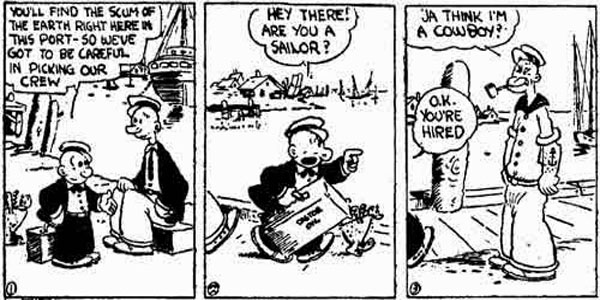
86 years ago today in the Thimble Theater comic strip a famous sailor man introduced himself to the American public. This sailor was of course Popeye the Sailor Man. So from January 17, 1929, here is Popeye's first appearance in comics.
http://cdn3.whatculture.com/wp-content/uploads/2014/09/Popeye_in_Thimble_Theatre.jpg
Of course what many of us know Popeye for today is the classic animated cartoons from the Fleshier Brothers. Popeye made his film debut on July 14, 1933. There was not a Popeye film series at this time. When the rights to use the character were purchased, the contract asked for a trail film before a series could begin. So this cartoon is actually a Betty Boop Cartoon. Betty Boop an original character created by animator Grim Natwick for the Fleshier Studio, was the studio's claim to fame at this time, and had been put in some of the funniest cartoons of the 1930's. Betty however only makes a quick cameo appearance in this film though, so it is much like the Popeye series had already begun. The animation of Betty Boop in this cartoon is reused from her previous film Bamboo Isle from 1932. Popeye's voice at this time was done by a radio comedian named William Costello. This would soon change as I will talk about in my introduction to the next cartoon. As was typical of Fleshier films from this era much of the supporting cast are animals. This is of course something that would change in later Popeye cartoons (Yeah this is a Betty Boop, but Popeye played the main role). So from 1933 and directed by Dave Fleshier, here is Popeye The Sailor Man.
https://www.youtube.com/watch?v=QURINUKpWKM
William Costello let fame get to his head. Therefore he became a pain to work with by always showing up late for recording, and other unprofessional things. Therefore he was replaced by Jack Mercer, who had done voices for the studio before. Luckily he could do a perfect Popeye impression. Jack Mercer was also a very funny person, he would often times adlib much of Popeye's dialog. Many times these adlibs would be among the funniest parts of the film. Mercer would later write some Popeye cartoons himself. Popeye was such a popular character that the Fleisher's felt his films could sustain an audience's interest for a longer length. Therefore 3 films were made that were 2 reels in length instead of the usual 1 reel. It was even thought about having him play the title role in the feature film Gulliver's Travels. This however never happened but we do have 3 great 2 reel Popeye films. From 1939 and directed by Dave Fleshier, here is Aladdin and His Wonderful Lamp.
https://www.youtube.com/watch?v=WtoKDEufmw8
Although character's from the comics other than Popeye, Bluto, Olive Oil, or Wimpy rarely appeared in these cartoons (Even rarer when Famous Studios did the series), their were occasions when these characters were used. Such an occasion was 1938's Goonland, a wonderful cartoon that makes me wish they would have used these characters more. So from 1938 and directed by Dave Fleshier, here is Goonland.
https://www.youtube.com/watch?v=Geealnaew5Q
-Michael J. Ruhland
Saturday, January 17, 2015

Wednesday, January 14, 2015
Terry-Toons Time #1
While The Terry-Toons studio has recived the attention that Disney, Warner Brothers Animation , The Fleshier Brothers Studio, or MGM Animation, they have brought us plenty of very entertaining shorts that deserve a good look. Formed by Paul Terry in 1929 Terry-Toons has given us such characters as Mighty Mouse, Heckle and Jeckle, Sidney The Elephant, John Doormat, and Gandy Goose.
Paul Terry and much of the Terry-Toons staff began their careers at the Aesop's Fables studio (Whose cartoons bore little to no relation to the Aesop's Fables stories that provided their namesake). These were shorts from the silent era that were very much a part of that time period. The however have oftentimes not dated as well as the Felix The Cat or Out Of The Inkwell shorts from the same time period. They remained silent for a good year after most cartoons had turned to sound. The early Terry-Toons were pretty much Aesop's Fables with some sound added. The cartoons have not adapted to the world of sound yet though, They are essentially silent films with a little bit of sound added. In fact some of them might have even worked better as silent films. These cartoons however do have their own charm. The following film is a perfect example of an early Terry-Toon. This also features the character of Farmer Alfalfa, who Paul Terry created back in back in 1915 for the short Down On The Funny Farm made for The Thanhouser Film Corporation. He carried this character over into his shorts for Aesop's Fables and to his Terry-Toons. The animation on the mermaid was animated by Disney legend Bill Tytla who played an important role in animating the dwarfs for Snow White and The Seven Dwarfs, as well as the Night On Bald Mountain sequence in Fantasia. So, from 1933 and directed by Frank Moser here is Tropicial Fish.
Paul Terry and much of the Terry-Toons staff began their careers at the Aesop's Fables studio (Whose cartoons bore little to no relation to the Aesop's Fables stories that provided their namesake). These were shorts from the silent era that were very much a part of that time period. The however have oftentimes not dated as well as the Felix The Cat or Out Of The Inkwell shorts from the same time period. They remained silent for a good year after most cartoons had turned to sound. The early Terry-Toons were pretty much Aesop's Fables with some sound added. The cartoons have not adapted to the world of sound yet though, They are essentially silent films with a little bit of sound added. In fact some of them might have even worked better as silent films. These cartoons however do have their own charm. The following film is a perfect example of an early Terry-Toon. This also features the character of Farmer Alfalfa, who Paul Terry created back in back in 1915 for the short Down On The Funny Farm made for The Thanhouser Film Corporation. He carried this character over into his shorts for Aesop's Fables and to his Terry-Toons. The animation on the mermaid was animated by Disney legend Bill Tytla who played an important role in animating the dwarfs for Snow White and The Seven Dwarfs, as well as the Night On Bald Mountain sequence in Fantasia. So, from 1933 and directed by Frank Moser here is Tropicial Fish.
Next up is an early cartoon in the career of Terry-Toons most famous star, Mighty Mouse(His 3rd cartoon in fact). Here though he is called Super Mouse as he was in his first 7 films. The name was later changed because there was a comic character called Super Mouse at this time and Paul Terry decided that it would not be right to compete with a character with the same name, You can easily see the changes in the style of Terry-Toons that occurred between this cartoon and the last film. This cartoon has stood the test of time better (not that the last one was bad by any means). So From 1943 and directed by Eddie Donnelly, here is He Dood It Again.
Last for today is one of the best and most creative Terry-Toons, The Magic Pencil. This Cartoon stars Gandy Goose and Sourpuss, Terry-Toons was found of giving their characters voices of popular actors of their day. These voices were not done by the actors themselves but were of course intimations. Gandy Goose was given an Ed Wynn voice, and Sourpuss was given a Jimmy Durante voice. Gandy's voice was supplied by Arthur Kay, and I do not know who did Sourpuss' voice. This cartoon was directed by Voleny White, who was an animator for some classic Looney Tunes and Merrie Melodies as well as a director for Terry-Toons. So from 1940 and directed by Voleny White here is The Magic Pencil.
-Michael J. Ruhland
Friday, January 9, 2015
Censored 11 part 2
The next cartoon of the censored 11 is one of the great Hollywood musical films. The great musical performance of "Swing For Sale", written by Saul Chaplin and Sammy Chan and proformed here by The Four Blackbirds and Danny Webb rivals performances from any of the other great Hollywood musicals of the 1930's. This film is another classic from animation legend Friz Freling. Freling excelled at musical cartoons and even after the obligatory song numbers were no longer a mandatory part of the Merrie Melodies series he continued using music heavily in his films. Scenes from this film were later reused in the cartoon "Have You Got an Castles" directed by Frank Tashlin. However that cartoon was not included in the censored 11, and is readily available on DVD. So from 1937 and directed by Friz Freling here is, Clean Pastures.
http://www.dailymotion.com/video/x98fju_clean-pastures-1937_shortfilms
Up next is a cartoon from another animation legend Tex Avery. Tex Avery had redefined the sense of humor and the style of story telling of Warner Brothers cartoons. Up until he came to Warners their cartoons had been very similar to those of Disney. This is not to say they weren't good (or even great) cartoons but the sense of originality that would later define them was missing. Although this is far from one of his best films at Warners it shows his style. Tex would make some of the funniest cartoons ever made both at Warners and MGM, and would play an important role in the creation of Daffy Duck, Bugs Bunny, and Droopy. So from 1937 and directed by Tex Avery, here is Uncle Tom's Bungalow.
http://www.dailymotion.com/video/x98rzz_uncle-tom-s-bungalow-1937_shortfilms
-Michael J. Ruhland
http://www.dailymotion.com/video/x98fju_clean-pastures-1937_shortfilms
Up next is a cartoon from another animation legend Tex Avery. Tex Avery had redefined the sense of humor and the style of story telling of Warner Brothers cartoons. Up until he came to Warners their cartoons had been very similar to those of Disney. This is not to say they weren't good (or even great) cartoons but the sense of originality that would later define them was missing. Although this is far from one of his best films at Warners it shows his style. Tex would make some of the funniest cartoons ever made both at Warners and MGM, and would play an important role in the creation of Daffy Duck, Bugs Bunny, and Droopy. So from 1937 and directed by Tex Avery, here is Uncle Tom's Bungalow.
http://www.dailymotion.com/video/x98rzz_uncle-tom-s-bungalow-1937_shortfilms
-Michael J. Ruhland
Friday, January 2, 2015
Censored 11 part 1
In 1968 United Artists decided to pull 11 classic Warner Brothers cartoons from distribution to both TV and Home Video. These 11 cartoons were pulled because they were deemed too racially offensive to a modern audience. However these cartoons are an important part of film history and therefore world history. Therefore this author feels these films should not be banned, because our history should not be banned from us.
Our first film is the only one, on the list, released during the Harmon and Ising era of Looney Tunes and Merrie Melodies. As I have mentioned in previous posts at this time Hugh Harmon was directing the Looney Tunes, and Rudolph Ising was directing the Merrie Melodies. This is one of Rudolph Ising's Merrie Melodies. This was the fifth Merrie Melody, and at this time Ising was trying to come up with staring characters for his Merrie Melodies. This idea though he soon abandoned and for a little while Merrie Melodies featured no starring characters. The character who stars in this cartoon is Piggy. Piggy had no personality to speak of, but in spite of that this cartoon remains quite entertaining. This film is also the only black and white cartoon from the censored 11. Those familiar with Disney cartoons will automatically notice similarities between this cartoon and the Silly Symphony, The Skelton Dance. However don't be too harsh on Rudolph Ising, at this time everyone in the animation business was coping Disney in at least some way. So from 1931 and directed by Rudolph Ising, here is Hittin' the Trail for Hallelujah Land.
https://www.youtube.com/watch?v=P8IvVXCSZng
Next comes a great musical cartoon from animation legend Friz Freling. The 1930's Merrie Melodies usually featured a musical number. At this time as well The Merrie Melodies were in color while Looney Tunes were in black and white. Later the musical numbers would be dropped for the most part, Looney Tunes would be in color, recurring characters would appear in Merrie Melodies (the same ones that appeared in Looney Tunes), and there would no longer be a difference between Looney Tunes and Merrie Melodies. However this is a great peak at what Merrie Melodies were like at this time. So from 1936 and directed by Friz Freling, here is Sunday Go to' Meeting Time.
https://www.youtube.com/watch?v=Q-qUqK5LovQ
-Michael J. Ruhland
Our first film is the only one, on the list, released during the Harmon and Ising era of Looney Tunes and Merrie Melodies. As I have mentioned in previous posts at this time Hugh Harmon was directing the Looney Tunes, and Rudolph Ising was directing the Merrie Melodies. This is one of Rudolph Ising's Merrie Melodies. This was the fifth Merrie Melody, and at this time Ising was trying to come up with staring characters for his Merrie Melodies. This idea though he soon abandoned and for a little while Merrie Melodies featured no starring characters. The character who stars in this cartoon is Piggy. Piggy had no personality to speak of, but in spite of that this cartoon remains quite entertaining. This film is also the only black and white cartoon from the censored 11. Those familiar with Disney cartoons will automatically notice similarities between this cartoon and the Silly Symphony, The Skelton Dance. However don't be too harsh on Rudolph Ising, at this time everyone in the animation business was coping Disney in at least some way. So from 1931 and directed by Rudolph Ising, here is Hittin' the Trail for Hallelujah Land.
https://www.youtube.com/watch?v=P8IvVXCSZng
Next comes a great musical cartoon from animation legend Friz Freling. The 1930's Merrie Melodies usually featured a musical number. At this time as well The Merrie Melodies were in color while Looney Tunes were in black and white. Later the musical numbers would be dropped for the most part, Looney Tunes would be in color, recurring characters would appear in Merrie Melodies (the same ones that appeared in Looney Tunes), and there would no longer be a difference between Looney Tunes and Merrie Melodies. However this is a great peak at what Merrie Melodies were like at this time. So from 1936 and directed by Friz Freling, here is Sunday Go to' Meeting Time.
https://www.youtube.com/watch?v=Q-qUqK5LovQ
-Michael J. Ruhland
Monday, December 22, 2014
Classic Christmas Cartoon Carnival #2
It is time for us to look at more of my favorite classic Christmas cartoons.
First off is the 1939 cartoon classic, Peace on Earth. On top of being a Christmas cartoon it is also an anti-war film. This leads to some amazing animation during the battle scenes. Very few animation fans will not be visually impressed by those scenes. This film was actually directed by Hugh Harmon, Co-founder of Looney Tunes. This cartoon begins looking like just another cute cartoon (of which Harmon was doing many of at this time) and then amazes you with what direction it goes in. This was also the very first MGM cartoon to be nominated for an academy award (although The Milky Way(1940) would be the first to win (the first non-Disney cartoon to win as well). So from 1939 and directed by Hugh Harmon, here is Peace on Earth.
https://www.youtube.com/watch?v=d8stkqssLYc
Peace on Earth, was remade in 1955 by William Hanna and Joesph Barbera. This remake was also the last film on which producer Fred Quimby's name appeared. he would go into retirement directly after. So from 1955 and directed by William Hanna and Joesph Barbera, here is Good Will Towards Men.
https://www.youtube.com/watch?v=K4AXC2rmLm0
Next up comes the Casper the Friendly Ghost cartoon, True Boo. After the failure of the feature film, Mr. Bug Goes to Town, and other problems Fleshier Studios was shut down. The were replaced by Famous Studios, which maintained many of the same people (minus the Fleshier Brothers, of course). Famous Studios continued series done at Fleshier's (Popeye, Superman), and also added new characters. One of the new characters was Casper the Friendly Ghost. Casper was originally created by Seymour Reit and Joe Oriolo, for a children's book. However the book was never made and the character was sold to Famous Studios. Famous Studios commonly reused ideas form old Fleshier films, and this film is quite similar to the Fleshier cartoon, Christmas Comes But Once a Year. However this cartoon has it's own unique charm to it. So from 1952 and directed by Izzy Sparber, here is True Boo.
https://www.youtube.com/watch?v=1W5LFaVWy0g
Now comes a classic Disney cartoon, Toy Tinkers. This is probably one of the funniest Disney cartoons. It is one in a series of Donald Duck VS Chip and Dale cartoons directed by Jack Hannah. Jack Hannah, along with Jack Kinnley, brought a lot of cartoon slapstick, and fast paced funny action to Disney cartoons, and therefore they are responsible for many of the funniest Disney films. So form 1949, and directed by Jack Hannah, here is Toy Tinkers.
https://www.youtube.com/watch?v=VjpT9QEnLdo
Next comes another Disney classic, Santa's Workshop. At this time Disney owned exclusive rights to Three Strip Technicolor. Therefore the color in this film is much more impressive than color cartoons from any other studio at this time. This film is virtually plot-less however to show off Three-Strip Technicolor was more than enough reason to make this film at the time. This film while a bit dated in some respects still remains a highly enjoyable cartoon, and the visuals are still quite impressive today. So from 1932 and Directed by Wilfred Jackson, here is Santa's workshop.
https://www.youtube.com/watch?v=v4c6Ay6diFo
Santa's Workshop received a sequel the next year. This film holds up even better in my opinion. So from 1933, and directed again by Wilfred Jackson, here is The Night Before Christmas.
https://www.youtube.com/watch?v=MlNnriyVYvo
Tom and Jerry's first Christmas cartoon was their third cartoon. This being done during the early years of Tom and Jerry, was much slower paced, and more realistically animated than what we associated with the cat and mouse. However in this film it works very well. The Christmas setting bring out a great atmosphere and the slower pace gives it plenty of time to sink in. So from 1941, and directed by William Hanna, and Joesph Barbera, here is The Night Before Christmas.
https://www.youtube.com/watch?v=D2Ck4G3Lm4A
-Michael J. Ruhland
First off is the 1939 cartoon classic, Peace on Earth. On top of being a Christmas cartoon it is also an anti-war film. This leads to some amazing animation during the battle scenes. Very few animation fans will not be visually impressed by those scenes. This film was actually directed by Hugh Harmon, Co-founder of Looney Tunes. This cartoon begins looking like just another cute cartoon (of which Harmon was doing many of at this time) and then amazes you with what direction it goes in. This was also the very first MGM cartoon to be nominated for an academy award (although The Milky Way(1940) would be the first to win (the first non-Disney cartoon to win as well). So from 1939 and directed by Hugh Harmon, here is Peace on Earth.
https://www.youtube.com/watch?v=d8stkqssLYc
Peace on Earth, was remade in 1955 by William Hanna and Joesph Barbera. This remake was also the last film on which producer Fred Quimby's name appeared. he would go into retirement directly after. So from 1955 and directed by William Hanna and Joesph Barbera, here is Good Will Towards Men.
https://www.youtube.com/watch?v=K4AXC2rmLm0
Next up comes the Casper the Friendly Ghost cartoon, True Boo. After the failure of the feature film, Mr. Bug Goes to Town, and other problems Fleshier Studios was shut down. The were replaced by Famous Studios, which maintained many of the same people (minus the Fleshier Brothers, of course). Famous Studios continued series done at Fleshier's (Popeye, Superman), and also added new characters. One of the new characters was Casper the Friendly Ghost. Casper was originally created by Seymour Reit and Joe Oriolo, for a children's book. However the book was never made and the character was sold to Famous Studios. Famous Studios commonly reused ideas form old Fleshier films, and this film is quite similar to the Fleshier cartoon, Christmas Comes But Once a Year. However this cartoon has it's own unique charm to it. So from 1952 and directed by Izzy Sparber, here is True Boo.
https://www.youtube.com/watch?v=1W5LFaVWy0g
Now comes a classic Disney cartoon, Toy Tinkers. This is probably one of the funniest Disney cartoons. It is one in a series of Donald Duck VS Chip and Dale cartoons directed by Jack Hannah. Jack Hannah, along with Jack Kinnley, brought a lot of cartoon slapstick, and fast paced funny action to Disney cartoons, and therefore they are responsible for many of the funniest Disney films. So form 1949, and directed by Jack Hannah, here is Toy Tinkers.
https://www.youtube.com/watch?v=VjpT9QEnLdo
Next comes another Disney classic, Santa's Workshop. At this time Disney owned exclusive rights to Three Strip Technicolor. Therefore the color in this film is much more impressive than color cartoons from any other studio at this time. This film is virtually plot-less however to show off Three-Strip Technicolor was more than enough reason to make this film at the time. This film while a bit dated in some respects still remains a highly enjoyable cartoon, and the visuals are still quite impressive today. So from 1932 and Directed by Wilfred Jackson, here is Santa's workshop.
https://www.youtube.com/watch?v=v4c6Ay6diFo
Santa's Workshop received a sequel the next year. This film holds up even better in my opinion. So from 1933, and directed again by Wilfred Jackson, here is The Night Before Christmas.
https://www.youtube.com/watch?v=MlNnriyVYvo
Tom and Jerry's first Christmas cartoon was their third cartoon. This being done during the early years of Tom and Jerry, was much slower paced, and more realistically animated than what we associated with the cat and mouse. However in this film it works very well. The Christmas setting bring out a great atmosphere and the slower pace gives it plenty of time to sink in. So from 1941, and directed by William Hanna, and Joesph Barbera, here is The Night Before Christmas.
https://www.youtube.com/watch?v=D2Ck4G3Lm4A
-Michael J. Ruhland
Friday, November 28, 2014
Classic Christmas Cartoon Carnival #1
Christmas is my favorite time of year and it is definitely one of the most important for many animation fans. So I am going to share some classic Christmas cartoons for all of you. So Sit back and enjoy.
First up is a classic Mickey Mouse cartoon directed by Burt Gillett. Gillett mainly directed Mickey Mouse cartoons while at Disney, although he would direct one of the most famous Silly Symphonies cartoons, "The Three Little Pigs". This would lead to him becoming in charge of the Van Beuren Studio's cartoons, where he unfortunately was never able to recapture the magic he did at Disney. However this one of his Disney cartoons and one of his best from 1932, when Walt Disney was still doing the voice of Mickey, here is "Mickey's Good Deed"
https://www.youtube.com/watch?v=ANlOFyhZJSI
Next comes a Christmas cartoon oddly released on January 7th 1933. This cartoon is a Merrie Melodies cartoon from the Harmon-Ising era of Looney Tunes/Merie Melodies. Hugh Harmon and Rudolph Ising started the series and were the head creative people on them, they even owned the rights to all the recurring characters (making these characters have disappear from the two series after 1933). The work was divided by having Hugh Harmon direct the Looney Tunes while Rudolph Ising directed the Merrie Melodies. This is when there was a difference between Looney Tunes and Merrie Melodies. Looney Tunes featured main characters (at this time Bosko and supporting cast) and were character, joke and story driven, while the Merrie Melodies featured mostly misalliances characters and were song driven. This is the perfect example of an early Rudolf Ising Merrie Melodie. It is fast, fun, unpretentious and centers around a very catchy song. From 1933 directed by Rudolf Ising, here is "The Shanty Where Santy Claus Lives".
https://www.youtube.com/watch?v=s1HA-J0Io4k
After there stint at Looney Tunes/Merrie Melodies Hugh Harmon and Rudolph Ising moved to MGM, where they were able to make there cartoons with higher budgets and in color. They took their characters such as Bosko and Honey with them, but they also created new characters as well. This is the introduction of one of those new characters, Little Cheeser. From 1935 and directed by Rudolph Ising here is "Alias St. Nick".
https://www.youtube.com/watch?v=sg9m5FCBWSw
Next Up a classic from the Fleshier Brothers. This is from the Color Classics series. Which ran from 1934 to 1941, and was meant to compete with Disney's very popular Silly Symphonies series. While these cartoons are often times considered weak rip offs of Silly Symphonies, and below the talents of the Fleshier Brothers (Who were truely great talents who I and many other consider masters of animation), the best of these series were absolute masterpieces. This is certainly one of the best Color Classics. It features the character Grampy, who had appeared in many Betty Boop cartoons, and was a great character in his own right. This is the only cartoon he appered in without Betty, and his only color cartoon, and it shows a great solo series could have been made with this character. From 1936, and directed by Dave Fleshier, here is "Christmas Comes But Once a Year"
https://www.youtube.com/watch?v=d4y8wj01MmU
Lastly for today comes an MGM cartoon, this time from animation legend Tex Avery. Tex Avery's MGM cartoons still stand out among the funniest cartoons ever made, and this cartoon perfectly shows why. The jokes fly at you at a fast pace and never let up and are often very funny. The father in this cartoon is voiced by Pinto Colvig, who had worked for Disney as a writer and the original voice of Goofy. The kid, and the wolf are voiced by Kent Rodgers who voiced Beaky Buzzard at Warner Brothers, and was one of the early voices for Wood Woodpecker at Walter Lantz. Kent Rodgers died during World War 2 leaving his voice career very short, but very enumerable. Enjoy this very funny classic Tex Avery cartoon from 1943, "One Ham's Family"
https://www.youtube.com/watch?v=g-Y2tENd3SM
-Michael J. Ruhland
First up is a classic Mickey Mouse cartoon directed by Burt Gillett. Gillett mainly directed Mickey Mouse cartoons while at Disney, although he would direct one of the most famous Silly Symphonies cartoons, "The Three Little Pigs". This would lead to him becoming in charge of the Van Beuren Studio's cartoons, where he unfortunately was never able to recapture the magic he did at Disney. However this one of his Disney cartoons and one of his best from 1932, when Walt Disney was still doing the voice of Mickey, here is "Mickey's Good Deed"
https://www.youtube.com/watch?v=ANlOFyhZJSI
Next comes a Christmas cartoon oddly released on January 7th 1933. This cartoon is a Merrie Melodies cartoon from the Harmon-Ising era of Looney Tunes/Merie Melodies. Hugh Harmon and Rudolph Ising started the series and were the head creative people on them, they even owned the rights to all the recurring characters (making these characters have disappear from the two series after 1933). The work was divided by having Hugh Harmon direct the Looney Tunes while Rudolph Ising directed the Merrie Melodies. This is when there was a difference between Looney Tunes and Merrie Melodies. Looney Tunes featured main characters (at this time Bosko and supporting cast) and were character, joke and story driven, while the Merrie Melodies featured mostly misalliances characters and were song driven. This is the perfect example of an early Rudolf Ising Merrie Melodie. It is fast, fun, unpretentious and centers around a very catchy song. From 1933 directed by Rudolf Ising, here is "The Shanty Where Santy Claus Lives".
https://www.youtube.com/watch?v=s1HA-J0Io4k
After there stint at Looney Tunes/Merrie Melodies Hugh Harmon and Rudolph Ising moved to MGM, where they were able to make there cartoons with higher budgets and in color. They took their characters such as Bosko and Honey with them, but they also created new characters as well. This is the introduction of one of those new characters, Little Cheeser. From 1935 and directed by Rudolph Ising here is "Alias St. Nick".
https://www.youtube.com/watch?v=sg9m5FCBWSw
Next Up a classic from the Fleshier Brothers. This is from the Color Classics series. Which ran from 1934 to 1941, and was meant to compete with Disney's very popular Silly Symphonies series. While these cartoons are often times considered weak rip offs of Silly Symphonies, and below the talents of the Fleshier Brothers (Who were truely great talents who I and many other consider masters of animation), the best of these series were absolute masterpieces. This is certainly one of the best Color Classics. It features the character Grampy, who had appeared in many Betty Boop cartoons, and was a great character in his own right. This is the only cartoon he appered in without Betty, and his only color cartoon, and it shows a great solo series could have been made with this character. From 1936, and directed by Dave Fleshier, here is "Christmas Comes But Once a Year"
https://www.youtube.com/watch?v=d4y8wj01MmU
Lastly for today comes an MGM cartoon, this time from animation legend Tex Avery. Tex Avery's MGM cartoons still stand out among the funniest cartoons ever made, and this cartoon perfectly shows why. The jokes fly at you at a fast pace and never let up and are often very funny. The father in this cartoon is voiced by Pinto Colvig, who had worked for Disney as a writer and the original voice of Goofy. The kid, and the wolf are voiced by Kent Rodgers who voiced Beaky Buzzard at Warner Brothers, and was one of the early voices for Wood Woodpecker at Walter Lantz. Kent Rodgers died during World War 2 leaving his voice career very short, but very enumerable. Enjoy this very funny classic Tex Avery cartoon from 1943, "One Ham's Family"
https://www.youtube.com/watch?v=g-Y2tENd3SM
-Michael J. Ruhland
Friday, November 7, 2014
Cartoons Go to War #1: Disney World War 2 Propaganda
Although many Disney films from the 1940's seem to be better remembered today than many other films from that era are, there are still some Disney films that have unfortunately been forgotten today. This is a shame since many of these are quite great films in there own right. Many of these forgotten ones were propaganda films made during World War Two. Today we are going to look at some of these classic films.
First up come a short Donald Duck cartoon that still ranks among the funniest films Disney has ever made. Originally planned to be named "Donald Duck and Nutzi Land" this cartoon's name had changed to "Der Fuehrer's Face" before being Released. The title was changed so because of the hit song "Der Fuehrer's Face" by Spike Jones and His City Slickers (the song plays a huge role in the finished song. The cartoon was directed by Jack Kinney, who after becoming a Disney director in 1940 brought a new fast paced satirical sense of humor to Disney cartoons that was completely different than what came before. He redefined the humor of Donald Duck, and Goofy cartoons, and many of his short cartoons remain just as funny today, and the following is a prefect example of why. From 1942, here is "Der Fuehrer's Face".
https://www.youtube.com/watch?v=3S8Zx1GfDrM
Next up comes something much more serious and terrifying. Based off the very political book by Gregor Ziemer, "Education for Death: The Making of a Nazi" is a horrifying portrait of Germany under control by the Nazi's, that was sadly probably not to far from the truth. The writer of the book had lived in Germany from 1928 to 1939, therefore was well familiar with the horrors of Hitler and the Nazi party, and shockingly Disney did not tone it down much for it's animated adaption. Leaving this one of the most horrifying and powerful films to have ever come out of Disney. From 1943, and directed by Clyde Geromini comes the brilliant short film, "Education for Death: The Making of a Nazi".
https://www.youtube.com/watch?v=l14WDZCnz-w
Lastly for today comes, Disneys most forgotten feature length animated film, "Victory Through Air Power". This is far from your average Disney movie, because it is completely World War Two Propaganda. Because of this, RKO Radio Pictures (Who was releasing Disney's films at the time) saw no profit in the movie (which there wasn't much profit for), therefore the film was released by Untied Artists. Based on the book by Alexander de Seversky (and featuring live action interludes with him) this film was an urge for America to focus more on an air force. Story goes that Winston Churchill urged Franklin D. Roosevelt to watch this film and it inspired FDR to put more thought into the air force for winning the war. Even with all the dated political propaganda in this film it features some great animation and manages to keep the film still very entertaining while delivering a serious political message. A must see for Disney, animation, and history buffs here is from 1943 "Victory Through Air Power".
https://www.youtube.com/watch?v=J7NjJ59bf0M
-Michael J. Ruhland
First up come a short Donald Duck cartoon that still ranks among the funniest films Disney has ever made. Originally planned to be named "Donald Duck and Nutzi Land" this cartoon's name had changed to "Der Fuehrer's Face" before being Released. The title was changed so because of the hit song "Der Fuehrer's Face" by Spike Jones and His City Slickers (the song plays a huge role in the finished song. The cartoon was directed by Jack Kinney, who after becoming a Disney director in 1940 brought a new fast paced satirical sense of humor to Disney cartoons that was completely different than what came before. He redefined the humor of Donald Duck, and Goofy cartoons, and many of his short cartoons remain just as funny today, and the following is a prefect example of why. From 1942, here is "Der Fuehrer's Face".
https://www.youtube.com/watch?v=3S8Zx1GfDrM
Next up comes something much more serious and terrifying. Based off the very political book by Gregor Ziemer, "Education for Death: The Making of a Nazi" is a horrifying portrait of Germany under control by the Nazi's, that was sadly probably not to far from the truth. The writer of the book had lived in Germany from 1928 to 1939, therefore was well familiar with the horrors of Hitler and the Nazi party, and shockingly Disney did not tone it down much for it's animated adaption. Leaving this one of the most horrifying and powerful films to have ever come out of Disney. From 1943, and directed by Clyde Geromini comes the brilliant short film, "Education for Death: The Making of a Nazi".
https://www.youtube.com/watch?v=l14WDZCnz-w
Lastly for today comes, Disneys most forgotten feature length animated film, "Victory Through Air Power". This is far from your average Disney movie, because it is completely World War Two Propaganda. Because of this, RKO Radio Pictures (Who was releasing Disney's films at the time) saw no profit in the movie (which there wasn't much profit for), therefore the film was released by Untied Artists. Based on the book by Alexander de Seversky (and featuring live action interludes with him) this film was an urge for America to focus more on an air force. Story goes that Winston Churchill urged Franklin D. Roosevelt to watch this film and it inspired FDR to put more thought into the air force for winning the war. Even with all the dated political propaganda in this film it features some great animation and manages to keep the film still very entertaining while delivering a serious political message. A must see for Disney, animation, and history buffs here is from 1943 "Victory Through Air Power".
https://www.youtube.com/watch?v=J7NjJ59bf0M
-Michael J. Ruhland
Subscribe to:
Posts (Atom)